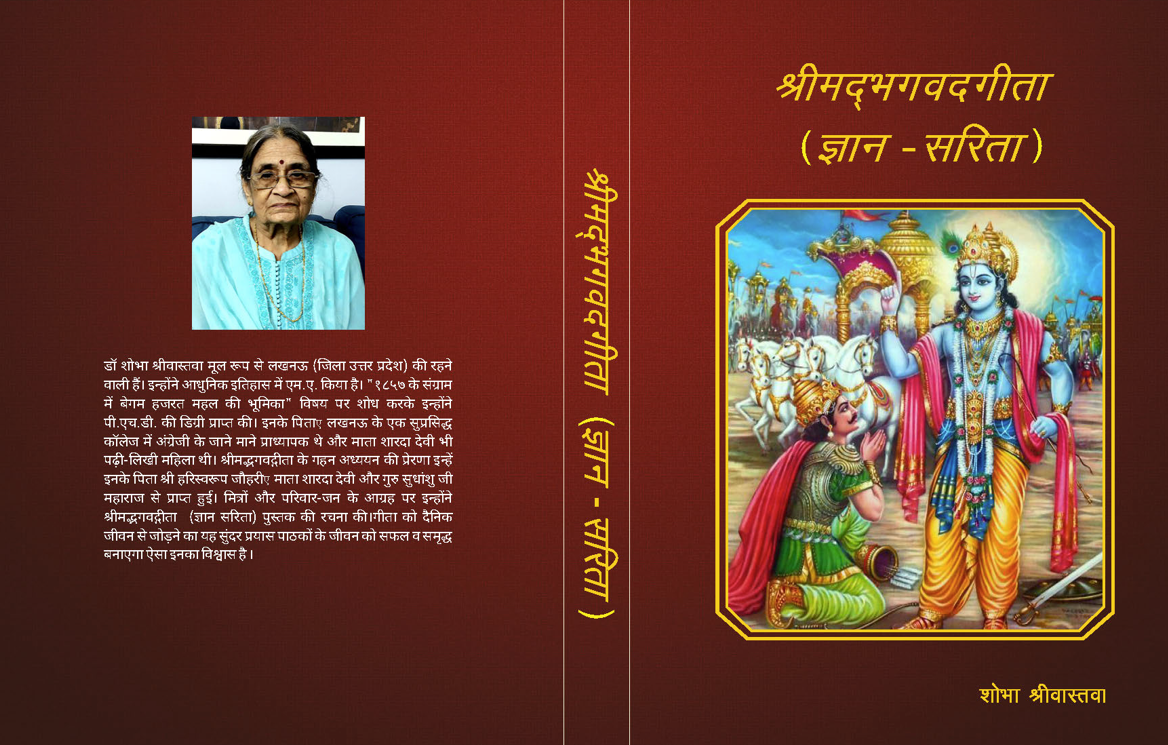
My book Gyan Sarita
If you need the pdf/E- copy of book please email to:- askshobha.srivastava@gmail.com
Language : HINDI
A chapter-wise summary of the book, which explores the spiritual teachings of the Bhagavad Gita and how they apply to human life..
Introduction: The Setting of the GitaThe book begins by explaining the profound mystery of the Gita, which was delivered by Lord Krishna to Arjuna on the battlefield of Kurukshetra. At the start of the great war, Arjuna is overwhelmed by Moh (attachment) and Vishada (despair) as he faces his relatives and teachers in battle. Krishna’s purpose in reciting the Gita is to turn Arjuna’s despondency into Prasada (grace) and his desire to flee into an awakening of his true self and duty.
Chapter 1: Vishada Yoga (The Yoga of Dejection)Arjuna is paralyzed by grief after seeing his uncles, brothers, and teachers armed for war. He argues that killing his kinsmen is a sin that will lead to the destruction of family traditions, social collapse, and hellish consequences. This chapter represents the “battlefield” within every human heart—the conflict between attachment and duty.
Chapter 2: Sankhya Yoga (The Yoga of Knowledge)Krishna begins his teaching by revealing the immortality of the soul (Atma) and the impermanence of the physical body. He explains that while the body is perishable, the soul is eternal and cannot be killed. Krishna urges Arjuna to perform his warrior’s duty (Swadharma) without worrying about victory or defeat. The chapter concludes with the description of the Sthitapragya—the person of steady wisdom who has conquered their senses and remains balanced in both pleasure and pain.
Chapter 3: Karma Yoga (The Yoga of Action)Krishna explains that no living being can remain without action even for a moment because everyone is driven by the three modes of nature (Gunas). He teaches that selfless action performed as a sacrifice (Yajna) is the path to purification and liberation. He clarifies that renunciation does not mean abandoning work but rather abandoning the desire for the fruits of action. Finally, he identifies desire (Kama) and anger (Krodha) as the greatest enemies of knowledge.
Chapter 4: Jnana Karma Sanyasa Yoga (The Yoga of Knowledge and Renunciation)Krishna reveals that He has incarnated throughout history to protect the righteous and re-establish Dharma. He explains the secret of “inaction in action”—how a person who is established in knowledge remains free from the bonds of karma even while performing duties. True knowledge acts as a fire that burns away the seeds of all past actions.
Chapter 5: Karma Sanyasa Yoga (The Yoga of Renunciation)This chapter addresses the choice between the renunciation of work and the yoga of action. Krishna explains that Karma Yoga (performing one’s duty selflessly) is superior for the common person because it is easier and leads to the same goal. A true devotee sees the same divine presence in a learned priest, a cow, an elephant, or even a dog.
Chapter 6: Atma Sanyama Yoga (The Yoga of Self-Control)Krishna provides practical instructions for meditation and self-discipline to steady the mind. He emphasizes that the mind can be a person’s best friend or worst enemy depending on whether it is controlled or not. He assures Arjuna that even a seeker who fails to achieve perfection in this life is never lost; they are reborn in a virtuous family to continue their spiritual progress.
Chapter 7: Jnana Vijnana Yoga (The Yoga of Knowledge and Realization)Krishna describes His divine energies, explaining that everything in the universe is pervaded by Him, like pearls on a string. He describes how the four types of devotees—the distressed, the seeker of wealth, the inquisitive, and the wise—approach Him. He is most pleased with the wise devotee who realizes that “Vasudeva (the Divine) is everything”.
Chapter 8: Akshara Brahma Yoga (The Yoga of the Imperishable Brahman)Arjuna asks for definitions of Brahman, the Self, and action. Krishna explains that whatever a person thinks of at the moment of death determines their next state of being. Therefore, one should practice remembering the Divine at all times while performing one’s duties.
Chapter 9: Raja Vidya Yoga (The Yoga of Sovereign Knowledge)Krishna calls this the “King of Knowledge”. He explains His role as the creator, sustainer, and final refuge of the universe. He emphasizes that he accepts even the smallest offering—a leaf, flower, fruit, or water—if it is given with pure devotion. He promises to provide for the needs and protect the spiritual gains (Yogakshema) of His devotees.
Chapter 10: Vibhuti Yoga (The Yoga of Divine Glories)Krishna reveals His infinite manifestations in the world to help Arjuna perceive the Divine in everything. He lists several examples: He is the sun among lights, the Ganges among rivers, and the mind among the senses. Every extraordinary or powerful thing in existence is but a small fragment of His glory.
Chapter 11: Vishwarupa Darshana Yoga (The Yoga of the Vision of the Universal Form)At Arjuna’s request, Krishna grants him “divine eyes” to see His Universal Form. Arjuna sees the entire cosmos, including all gods, beings, and the destruction of the warriors on the battlefield, contained within Krishna. Overwhelmed by this terrifying and awesome sight, Arjuna begs Krishna to return to His familiar, gentle human form.
Chapter 12: Bhakti Yoga (The Yoga of Devotion)Krishna clarifies that while the worship of the unmanifest Divine is possible, it is much more difficult for humans than the path of manifest devotion. He lists the qualities of a devotee who is “most dear” to Him: one who is free from hatred, compassionate, balanced in joy and sorrow, and completely surrendered to the Divine.
Chapter 13: Kshetra-Kshetrajna Vibhaga Yoga (The Yoga of the Field and Knower)Krishna defines the physical body as the “Field” (Kshetra) and the conscious soul as the “Knower of the Field” (Kshetrajna). He explains that true knowledge consists of understanding the difference between the material body and the eternal soul.
Chapter 14: Gunatraya Vibhaga Yoga (The Yoga of the Three Modes of Nature)The world is governed by three qualities: Sattva (purity), Rajas (passion), and Tamas (ignorance). These modes bind the soul to the body and determine a person’s behavior and rebirth. Krishna describes the “Gunatita”—one who has transcended these three modes and achieved absolute peace.
Chapter 15: Purushottama Yoga (The Yoga of the Supreme Person)Using the metaphor of an upside-down banyan tree, Krishna describes the material world and the need to cut its roots with the “axe of detachment”. He identifies Himself as the Supreme Person (Purushottama) who is beyond both the perishable matter and the imperishable soul.
Chapter 16: Daivasura Sampad Vibhaga Yoga (The Yoga of the Divine and Demoniac)Krishna distinguishes between divine qualities (like fearlessness, purity, and charity) and demoniac traits (like pride, anger, and greed). He warns that lust, anger, and greed are the three gates to hell and must be abandoned.
Chapter 17: Shraddhatraya Vibhaga Yoga (The Yoga of the Threefold Faith)Krishna explains how a person’s faith, the food they eat, the sacrifices they perform, and the charity they give are all categorized by the three Gunas. He teaches the sacred mantra “Om Tat Sat” as a way to purify all actions.
Chapter 18: Moksha Sanyasa Yoga (The Yoga of Liberation through Renunciation)The final chapter summarizes the Gita’s entire message. Krishna clarifies that true renunciation is the giving up of selfish desire, not the abandonment of duty. He emphasizes that total surrender to God is the ultimate path to peace. The book concludes with Sanjaya’s realization: wherever there is Krishna (the Lord of Yoga) and Arjuna (the supreme archer/seeker), there will always be prosperity and victory.